- On 10 April, the Estonian Refugee Council’s portrait exhibition “Voices from Crises: Stories of Displaced People” opened in Tartu as part of Gallery Night at Aparaaditehas. The exhibition tells the stories of refugees living in Estonia and will remain open until 1 June 2026.
- A refugee youth-led project called “Noortepulss” has started in Estonia, focusing on building a community in Tartu where both young people and older people can meet and take part in activities together.
- Family events in Tartu that support community feeling and help people with refugee backgrounds adjust to life in Estonia have also begun successfully.
- In Ukraine, 39 generators and 48 battery stations purchased with support from Estonian donors and the Estonian Ministry of Foreign Affairs have now been delivered.
- By the end of March, Ukraine’s mental health helpline had received more than 5,830 calls.
- In Armenia, a public forum was held by a community council led by people with refugee backgrounds who are advocating for their rights. The discussion focused on housing and legal issues.
Ukraine
This winter of war has been exceptionally difficult for the people of Ukraine due to severe cold and constant attacks. We collected donations in Estonia to purchase generators, fuel, and other essential items for crisis and evacuation centres, so that operations can continue under extreme winter conditions and people fleeing the daily Russian attacks would have the critical support they need. As of today, 39 generators and 48 high-capacity battery stations have been delivered. In total, the plan is to deliver 45 generators and 55 battery stations. The procurement of generators is also financially supported by the Estonian Ministry of Foreign Affairs.
We provide cash assistance, which allows people affected by the war to purchase food, medicines, hygiene products, and other essentials. As of now, we have provided cash-based assistance to more than 330,000 conflict-affected people, worth more than 61,8 million euros. Cash assistance is provided for three months, with the support of 3600 Ukrainian hryvnias per household member per month, equivalent to about 73 euros. Registration for assistance is carried out through Estonian Refugee Council's local registration points or via the online application platform. Currently, our focus is on assisting those in need in frontline areas in Zaporizhzhia, Donetsk, Luhansk, Kharkiv, and Kherson oblasts. The programme is supported by the European Union, the US Government, and the Estonian Ministry of Foreign Affairs. Acted is the lead partner for EU and US-supported projects.
We support livelihood activities related to agriculture, livestock, food production, and various services through emergency assistance, with the aim of strengthening people’s self-reliance. The support amount is around 700 euros. By the end of March we have shared 209 grants across five oblasts – Zaporizka, Dnipropetrovska, Poltavska, Kirovohradska, and Cherkaska. The programme is funded by the European Union, the US Government, and the Ministry of Foreign Affairs of Estonia.
We run entrepreneurship programmes to help people affected by war create sustainable sources of income for themselves. We support new and existing businesses in Poltava, Cherkasy, Dnipro, Kirovohad, and Kharkiv oblasts. In March, we gave out 47 business grants in the amount of more than 148,000 euros. As of today, we have distributed a total of 105 grants worth more than 326,000 euros. The project is developed in partnership with Acted and supported by the US Government.
We provide psychosocial support via a mental health hotline for Ukrainians living both in Ukraine and abroad to support the people affected by the war. Since May last year, more than 5,830 calls have been made on the hotline. Read articles with hotline consultants Olena and Olha on the ERC website. The work of the NPA Psychological Hotline is implemented in partnership with the National Psychological Association of Ukraine and made possible thanks to funding from ESTDEV – Estonian Centre for International Development.
Estonia
Through the Language Ladder project, we support Ukrainian refugee youth in language learning and social integration. As of the end of March, a total of six youth events have taken place across Estonia: visits to VOCO and the Tartu Art School in Tartu, as well as training sessions on entrepreneurship, employment and artificial intelligence, and a design and creativity workshop in Tallinn with Kirill Safonov. Read more on ERC's website. As part of the project, we are running the MindSpring group programme for people with a refugee background, supporting their adaptation to life in a new and unfamiliar country. In March, the meetings of the Jõhvi group came to an end, and a new group was launched in Tallinn, with 12 young people taking part. Read more about the “invisible language learning” methodology used in the project on the Estonian Refugee Council’s website. The project is being implemented in collaboration with Tallinn University and the Polish organisation Dobra Fabryka. Funded by the European Union. Views and opinions expressed are however those of the author(s) only and do not necessarily reflect those of the European Union or European Social Fund Agency. Neither the European Union nor the Granting Authority can be held responsible for them.
The refugee youth-led project Youth Pulse has been launched, focusing on building a community in Tartu where both young people and older residents come together. Through a range of activities, the project develops and strengthens intergenerational relationships to help newcomers adapt more easily. The first successful meet-up took place at the beginning of April at the Tartu Nature House. Funded by the European Union. Views and opinions expressed are however those of the author(s) only and do not necessarily reflect those of the European Union or the European Education and Culture Executive Agency (EACEA). Neither the European Union nor EACEA can be held responsible for them. The project is supported by the Estonian Agency for Erasmus+ and the European Solidarity Corps from the Erasmus+ program.
In March, family events in Tartu got underway, supporting a sense of community and integration among people with refugee backgrounds. Participants watched the film “Supilinna salaselts” together and visited the A. Le Coq Beer Museum to learn more about their home city, Tartu, and its history. A total of 49 people took part in the family events in March. The project is supported through donations collected among members of the British–Estonian Chamber of Commerce.
We conduct monthly adaptation support training sessions on various subjects, including use of e-services, parenting, education system, adaptation of pensioners, legal matters, entrepreneurship, medical and social system, labour market, as well as legal foundations and residence permits. In March, 264 people took part in the trainings. The most popular sessions were the legal training courses related to the extension of temporary protection, as well as the rights and opportunities offered by different types of residence permits in Estonia. This was followed by a seminar on the necessary steps for people with refugee backgrounds from Ukraine to electronically submit their employment record data to the Ukrainian Pension Fund. Since 2022, a total of nearly 13,800 people have participated.
We organise regular group activities and community events across Estonia. Regular language cafés continued in Tallinn, the language-learning programme, Language Roulette, also continued.
In cooperation with the Integration Foundation, we are giving seminars to strengthen the capacity of local governments in the fields of migration and integration. In 2026, seminars have already taken place in Haapsalu, Pärnu, Võru, Valga, Kärdla, Põlva, Põltsamaa and Kuressaare. Cultural sensitivity training sessions have been held in Pärnu and Tallinn. Further training activities are planned in Tallinn and Tartu in the spring. In total, 15 seminars and training sessions are planned across Estonia in the first half of the year. The project is co-funded by the European Union through the Asylum, Migration and Integration Fund (AMIF) and the Ministry of the Interior.
In cooperation with the Integration Foundation, we began organising various events across Estonia to increase the civic engagement of third-country nationals, including beneficiaries of international protection. The aim is to strengthen mutual understanding and trust, and to help third-country nationals cope better with everyday life and participate more actively in society. In March, participants attended a public speaking seminar at the ERR News House and took part in a tour of the television studios, getting a behind-the-scenes look at how television is made. Project no. AMIF.1.02.23-0005 “Cooperation activities to increase the civic engagement of third-country nationals, including beneficiaries of international protection” is co-funded by the Asylum, Migration and Integration Fund (AMIF).
We provide counselling by appointment at the Estonian Refugee Council office (Vambola 6, Tallinn) every day from 10 am to 5 pm. Our information hotline is open to all refugees, as well as institutions and individuals assisting them, at +372 5881 1311 (Monday to Friday from 10 am to 5 pm), and via email at counselling@pagulasabi.ee.
Armenia
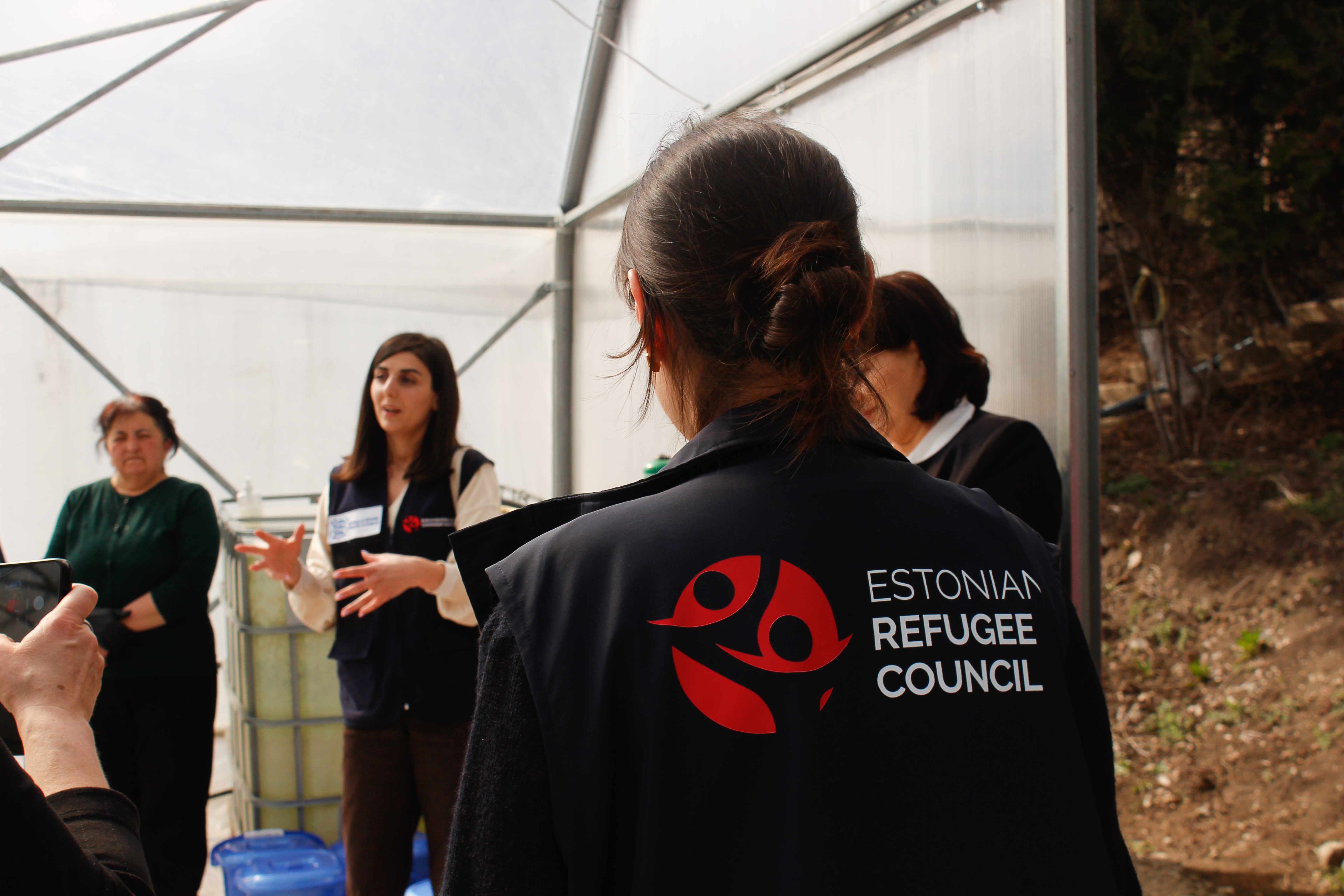
Hydroponic greenhouses established at three schools in the Tavush region of Armenia help introduce water- and energy-efficient agricultural solutions developed in Estonia. Through the programme, we support schools in adapting to climate change and ensuring food security in water-scarce conditions. We also promote children’s environmental education and increase students’ engagement in agricultural and environmental topics. In March, experts from the Estonian University of Life Sciences visited the greenhouses to help improve the composting and hydroponic cultivation activities, and discuss opportunities and challenges. Students shared their ideas for promoting sustainable agriculture and presented the work they had carried out. Read more about the programme on ERC’s website. The programme is funded by the Ministry of Climate of the Republic of Estonia.
Thanks to funding from the European Union, we have launched four community councils so people with refugee backgrounds can voice their concerns and take part in decision-making processes that affect them. In March, additionally to regular monthly activities, the Yerevan Community Council organised and hosted a public forum on housing and legal issues that brought together a variety of stakeholders, including state and NGO representatives, construction companies and international actors from the EU Delegation and the Swedish Embassy. Additionally, the councils evaluated submitted initiatives. The next step is preparing recommendation packages to the relevant state bodies.
We are also running self-help groups that support the mental well-being of people with a refugee background and provide them with practical skills and support to start or restore small businesses and secure sustainable livelihoods. In March, the Abovyan and Yerevan groups completed the 8-day programme: 12 participants from each group received certificates. The next step is submitting applications for business grants. The programme is funded by the European Union.
Lebanon
The Estonian Refugee Council will soon begin providing humanitarian aid in Lebanon in cooperation with the local organisation Nusaned, in order to ease the deepening humanitarian crisis caused by the armed conflict and to support people in the most vulnerable situations.
We will distribute hot meals, food parcels and essential basic items to internally displaced people, particularly families with children, older people and people with disabilities. The programme is supported by the Estonian Ministry of Foreign Affairs.