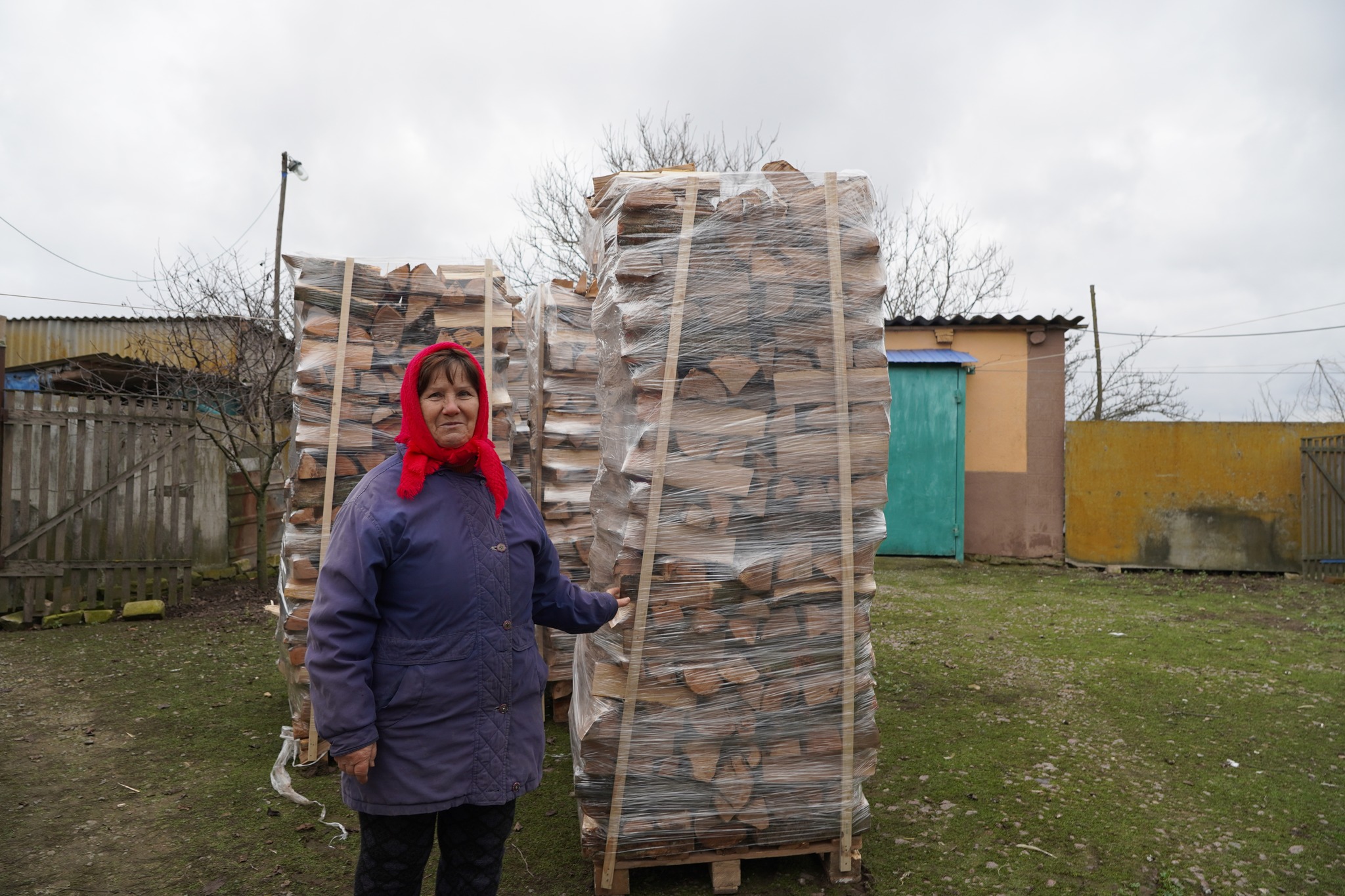
- With the support of donors in Estonia, we raised €30,000 to provide winter heating assistance to families living near the front lines in Ukraine.
- On 6 December, the Estonian Refugee Council celebrated 25 years of supporting people who have lost their homes and sense of security. Over this time, we have supported more than 470,000 people affected by crises.
- In Estonia, more than 300 people participated in adaptation training, and over 330 people took part in community activities in December.
- In Ukraine, we supported more than 170 families in Dnipropetrovska and Zaporizhzhia oblasts with cash-based livestock livelihoods support.
- Since October, nearly 4,290 families in frontline and hard-to-reach areas of Eastern and Southern Ukraine – including Donetsk, Kharkiv, Kherson, Luhansk, and Zaporizhzhia oblasts – have received winter heating assistance.
- In Georgia, we provided winter livelihoods support to 515 people who fled Ukraine, helping them cover their basic needs during the colder months.
- In Syria, we distributed cash-based humanitarian assistance to 65 people in the Latakia region to help alleviate the consequences of the summer wildfires.
Ukraine
We provide cash assistance, which allows people affected by the war to purchase food, medicines, hygiene products, and other essentials. As of now, we have provided cash-based assistance to more than 315,000 conflict-affected people, worth more than 58.6 million euros. Cash assistance is provided for three months, with the support of 3600 Ukrainian hryvnias per household member per month, equivalent to about 73 euros. Registration for assistance is carried out through Estonian Refugee Council's local registration points or via the online application platform. Currently, our focus is on assisting those in need in frontline areas in Zaporizhzhia, Donetsk, Luhansk, Kharkiv, and Kherson oblasts. The programme is supported by the European Union, the US Government, and the Estonian Ministry of Foreign Affairs. Acted is the lead partner for EU and US-supported projects.
We support livelihood activities related to agriculture, livestock, food production, and various services through emergency assistance, with the aim of strengthening people’s self-reliance. The support amount is around 700 euros. In 2025 we supported more than 420 families from Poltavska, Kirovohradska, Cherkasy, Zaporizska oblasts. The programme will continue throughout 2026. The programme is funded by the European Union, the US Government, and the Ministry of Foreign Affairs of Estonia.
We support new and existing businesses in Poltava, Kirovohrad, Cherkasy, Dnipro, and Kharkiv through a self-employment programme offering online training, mentoring, and business micro-grants. In December, we launched a call for applications for the second training cohort, with more than 280 participants starting their online training in January. Launched in September, the first cohort included 120 participants who completed the training and developed business plans, with 106 entrepreneurs receiving cash grants and four months of mentorship. The project is developed in partnership with Acted and supported by the US Government.
We supported more than 170 families in Dnipropetrovska oblast (Kryvorizhzhskyi and Synelnikivskyi raions) and Zaporizka oblast (Zaporizhzhskyi raion) through our cash-based winterisation livelihoods support for livestock assistance. The support amount was up to 550 euros per family in line with their specific livestock and poultry winterisation needs. The programme is funded by the European Union and the Ministry of Foreign Affairs of Estonia.
This winter, we will assist over 5,000 vulnerable families with heating aid. We are providing both financial and in-kind support to help cover rising heating costs and ensure fuel supplies for the winter. Since the start of the winter response period this season, nearly 4,290 vulnerable families have been supported, of which more than 4000 families received cash for winter heating assistance, and 285 families received solid fuel delivered to their homes. We are focusing on frontline and hard-to-reach areas in Eastern and Southern Ukraine, specifically in Donetsk, Kharkiv, Kherson, Luhansk, and Zaporizhzhia oblasts, where intensified hostilities and damaged infrastructure have severely hindered people's ability to meet their basic winter heating needs. The programme is supported by the European Union, the US Government, the United Nations Office for the Coordination of Humanitarian Affairs (OCHA) through the Ukraine Humanitarian Fund (UHF), and the Estonian Ministry of Foreign Affairs. Acted is the lead partner for EU and US-supported projects. National NGOs Shchedryk and Peaceful Heaven of Kharkiv are the sub-implementing partners for the UHF project.
Through a campaign launched at the end of November, we raised €30,000 with the support of donors in Estonia to provide winter heating assistance to families living near the front lines in Ukraine. This allows us to reach additional people in need, beyond the families we already support through institutional funding. Since there are so many in need in the region, donations from individuals give us the opportunity to help more people and respond more flexibly to urgent needs. Donations are accepted year-round via the Estonian Refugee Council’s donation platform.
We provide psychosocial support via a mental health hotline for Ukrainians living both in Ukraine and abroad to support the people affected by the war. In the past eight months more than 3,720 calls have been made on the hotline. The work of the NPA Psychological Hotline is implemented in partnership with the National Psychological Association of Ukraine and made possible thanks to funding from ESTDEV – Estonian Centre for International Development.
Estonia
Through the Language Ladder project, we support Ukrainian refugee youth in language learning and social integration. In December, we continued with the implicit language learning methodology meetings meant for young people aged 13–18 and developed by Tallinn University. In Tallinn, four groups meet weekly, and in Jõhvi two. As part of the project, we are running the MindSpring group programme for people with a refugee background, supporting their adaptation to life in a new and unfamiliar country. In December, group sessions were held for young people in Tallinn. In January, the programme will be open to young people in Ida-Viru County, and a new group will start in Jõhvi in March. The project is being implemented in collaboration with Tallinn University and the Polish organisation Dobra Fabryka. Funded by the European Union. Views and opinions expressed are however those of the author(s) only and do not necessarily reflect those of the European Union or European Social Fund Agency. Neither the European Union nor the Granting Authority can be held responsible for them.
We conduct monthly adaptation support training sessions on various subjects, including use of e-services, parenting, education system, adaptation of pensioners, legal matters, entrepreneurship, medical and social system, labour market, as well as legal foundations and residence permits. The training sessions take place across Estonia, both in face-to-face and online formats. In December, more than 300 people took part in training sessions. Training sessions on residence permits continued to attract the most interest, which shows that the topic remains highly relevant. Since 2022, a total of nearly 13,100 people have participated.
We provide counselling by appointment at the Estonian Refugee Council office (Vambola 6, Tallinn) every day from 10 am to 5 pm. Our information hotline is open to all refugees, as well as institutions and individuals assisting them, at +372 5881 1311 (Monday to Friday from 10 am to 5 pm), and via email at counselling@pagulasabi.ee.
We organise regular group activities and community events across Estonia. December was full of events – over 330 people with a refugee background from Ukraine and other countries participated in community activities. In Tallinn, regular language café meetings were held, along with Christmas-themed gatherings and workshops. In Rakvere, we supported a Ukrainian children’s football school, and in Kohtla-Järve, a concert featured Ukrainian choirs from different cities. We also organised Christmas meetings in Tartu and arranged a trip to Tartu for young people from Ida-Viru County. Community activities were supported by UNHCR, the UN Refugee Agency.
In cooperation with the Integration Foundation, we are launching training activities to strengthen the capacity of local governments in the fields of migration and integration. In 2025, training sessions were held for local government officials and community representatives from Järva, Rapla, Viljandi, Lääne, and Ida-Viru counties, with a total of 60 participants. The next sessions will take place in Haapsalu on 20 January and in Pärnu on 27 January. In February, training sessions are scheduled for Võru on 3 February, Valga on 10 February, and Kärdla on 18 February. In total, 20 training sessions are planned across Estonia. The project is co-funded by the European Union through the Asylum, Migration and Integration Fund (AMIF) and the Ministry of the Interior.
In cooperation with the Integration Foundation, we began organising various events across Estonia to increase the civic engagement of third-country nationals, including beneficiaries of international protection. The aim is to strengthen mutual understanding and trust, and to help third-country nationals cope better with everyday life and participate more actively in society. In December, we organised a meeting for parents of teenagers in Tartu, where they could raise concerns and questions with a lecturer and discuss important topics with other participants. In the afternoon, the day continued at Tartu Nature House with a Christmas-themed craft workshop and an exploration tour. At the year-end event in Tallinn, participants visited Swedbank’s interactive financial literacy centre and attended a finance-themed lecture, tried their hand at a marzipan workshop at Maiasmokk, and explored Tallinn’s Old Town with a guide. Project no. AMIF.1.02.23-0005 “Cooperation activities to increase the civic engagement of third-country nationals, including beneficiaries of international protection” is co-funded by the Asylum, Migration and Integration Fund (AMIF).
Armenia
In the Tavush region, the cultivation process in the hydroponic greenhouses was smoothly organised and carried out by greenhouse workers in close coordination with agronomists and with the active involvement of schoolchildren. Read more about the programme on ERC’s website. The programme is funded by the Ministry of Climate of the Republic of Estonia.
Training sessions for the administrative staff and teachers of Achajur, Sevkar, and Koghb Secondary School No. 2 continued, aimed to provide practical knowledge and tools on sustainable approaches to addressing the challenges of climate change. Additionally, enhance student learning. The project is funded by the Women’s Fund Armenia.
Thanks to funding from the European Union, we have launched four community councils to enable people with refugee backgrounds to voice their concerns, and take part in decision-making processes that affect them. During December, community councils held their regular monthly meetings. In addition, based on needs assessments, capacity-building sessions for community council members on a variety of topics, including team building, human rights, refugee rights, and legal documentation were held.
We are also running self-help groups that support the mental well-being of people with a refugee background and provide them with practical skills and support to start or restore small businesses and secure sustainable livelihoods. So far, we have started six groups in different locations. In December, 10 people from the two latest self-help groups were selected to receive livelihood grants in January. Mentors continued providing mentorship support to the previous 27 grantees and will begin supporting the ten new grantees from January. Two new self-help groups were formed in Yerevan and Abovyan that will start work in January. There is a psychologist supporting the self-help groups. The programme is funded by the European Union.
Georgia
In December, we finalised our cash-based winterisation assistance programme aimed at Ukrainian refugees living in Georgia, providing vital support during the coldest months of the year to a total of 180 families (about 515 people). Each family received 1,500 GEL (around 480 euros) to help cover their essential winter-related needs, including utility costs, heating, and warm clothing.
Syria
We supported 65 families with emergency cash based humanitarian assistance living in rural Latakia province to help them fight the consequences of the wildfires. The programme is funded by the Estonian Ministry of Foreign Affairs and implemented in partnership with Finn Church Aid. The programme is funded by the Estonian Ministry of Foreign Affairs and implemented in partnership with Finn Church Aid.
Occupied Palestinian territories
We delivered the last food parcels to the medical staff and patients in Gaza hospitals in December. In 2025, we delivered more than 12,000 meals to help alleviate the impacts of famine, thanks to donations from people in Estonia and funding from the Estonian Ministry of Foreign Affairs. The programme is funded by the Estonian Ministry of Foreign Affairs and in partnership with a local organisation Gaza Soup Kitchen.